How to Monitor Control Valve Health with Smart Valve Positioners
A control valve may continue to operate even when its performance is gradually deteriorating. Small increases in friction, slow response, air leakage or position deviation may not immediately stop the process, but they can eventually lead to unstable control, unexpected maintenance and unplanned downtime.
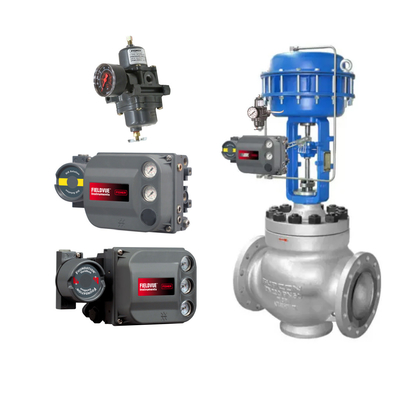
This is where a smart valve positioner can provide more than basic valve positioning. By collecting operating and diagnostic data, a smart positioner can help operators and maintenance teams monitor the condition of the valve assembly and identify potential problems at an earlier stage.
1. What Is a Smart Valve Positioner?
A traditional valve positioner mainly helps ensure that the control valve reaches the required position according to the input signal.
A smart valve positioner adds digital processing and diagnostic functions. Depending on the model and configuration, it can collect information related to:
-
Valve position
-
Input signal
-
Actuator pressure
-
Valve travel
-
Response time
-
Supply pressure
-
Friction
-
Alarms
-
Calibration status
This information can be used to understand how the control valve is performing during normal operation.
2. Why Monitor Control Valve Health?
Control valves operate continuously in many process plants. Over time, mechanical components, packing, actuator parts and valve trim can experience wear.
Common problems include:
Without diagnostic information, these problems may only become obvious after the valve begins affecting the process.
Continuous monitoring provides another approach: identify changes in valve behavior and investigate them before they become a major operational problem.
3. Monitor Valve Position and Travel
One of the most useful parameters is the relationship between the valve's commanded position and actual travel.
For example, the control system may request a 50% valve position, while the valve repeatedly remains slightly above or below the expected position.
A single deviation does not necessarily indicate a failure. However, repeated or increasing deviation may indicate:
Trend information is often more useful than looking at one measurement at a single point in time.
4. Monitor Friction and Valve Movement
Friction can have a major effect on control valve performance.
Excessive friction may cause the valve to stick before suddenly moving. This can create poor control, oscillation or a difference between the requested and actual valve position.
Smart valve diagnostics can help identify abnormal friction behavior and track changes over time.
If friction gradually increases, maintenance personnel can investigate possible causes such as:
-
Packing condition
-
Stem problems
-
Valve trim issues
-
Mechanical alignment
-
Actuator condition
Early investigation can be more practical than waiting for the valve to fail during operation.
5. Monitor Instrument Air and Actuator Pressure
For pneumatic control valves, the condition of the instrument air system is closely related to valve performance.
A smart positioner can provide information about actuator pressure and supply conditions, depending on the device configuration.
Abnormal pressure behavior may indicate:
This means the positioner can provide information not only about the valve but also about parts of the actuator and pneumatic system.
6. Use Diagnostic Trends Instead of Single Readings
A single diagnostic reading may not tell the complete story.
For example, a control valve may have slightly higher friction today than yesterday. That does not automatically mean the valve needs immediate replacement.
However, if the trend shows that friction has been increasing steadily over several weeks, the information becomes more useful for maintenance planning.
A practical monitoring process can be:
Collect Data → Identify Deviation → Check Trend → Investigate Cause → Plan Maintenance
This approach helps maintenance teams focus on valves that show meaningful changes rather than treating every valve in the same way.
7. Smart Positioners and Predictive Maintenance
Smart valve positioners can become part of a predictive maintenance strategy.
Instead of maintaining every valve according to the same fixed schedule, plants can use diagnostic information to identify equipment that requires closer attention.
For large plants with hundreds or thousands of control valves, this can be particularly useful.
Diagnostic data can be combined with plant asset management or valve monitoring software to create a broader view of the installed valve population.
The goal is not simply to collect more data. The important part is turning the data into useful maintenance decisions.
8. What Problems Can Smart Valve Diagnostics Help Identify?
Depending on the positioner and diagnostic system, monitoring can help identify signs of:
The exact diagnostic functions depend on the positioner model, communication protocol and software configuration.
9. Smart Valve Positioner Examples
Several industrial manufacturers offer smart valve positioners with diagnostic capabilities.
Common examples include:
-
Fisher FIELDVUE DVC6200
-
Fisher FIELDVUE DVC7K
-
Neles ND9000
-
Masoneilan SVI series
-
Flowserve Logix series
-
Azbil AVP series
-
Tissin TS900 / TS905
The available diagnostic functions vary between models, so the specific configuration should be checked before selecting a positioner.
10. What Information Should Be Monitored?
For a practical valve health monitoring program, consider tracking:
| Parameter |
What It Can Indicate |
| Valve Position |
Actual operating position |
| Travel |
Movement and response |
| Input Signal |
Control command |
| Actuator Pressure |
Pneumatic performance |
| Supply Pressure |
Instrument air condition |
| Friction |
Mechanical resistance |
| Response Time |
Valve movement performance |
| Alarms |
Potential abnormal conditions |
| Calibration Status |
Position accuracy |
Trend analysis becomes more valuable when these parameters are reviewed together.
11. How to Start Monitoring Valve Health
A practical approach does not necessarily require replacing every positioner in a plant.
Start with critical control valves where failure could have a significant effect on:
-
Production
-
Safety
-
Process stability
-
Product quality
-
Maintenance cost
Then identify which existing valves already have digital diagnostic capabilities.
For older valves, upgrading the positioner may provide additional diagnostic information, but compatibility with the valve, actuator, mounting system, signal and communication protocol must be checked.
Conclusion
A smart valve positioner can do more than move a control valve to the requested position. With the right configuration, it can provide useful information about valve travel, actuator pressure, friction, response and abnormal operating conditions.
The basic monitoring process is:
Measure → Trend → Detect Changes → Investigate → Plan Maintenance
For plants with a large number of control valves, this approach can help maintenance teams move from reactive troubleshooting toward more condition-based and predictive maintenance.
We supply smart valve positioners from manufacturers including Fisher, Neles, Masoneilan, Flowserve, Azbil and Tissin, as well as related control valve and actuator solutions.
If you are planning to replace an existing positioner or add valve diagnostics, provide the existing valve model, actuator, signal and communication requirements for configuration checking.


 Ihre Nachricht muss zwischen 20 und 3.000 Zeichen enthalten!